Why this is better than a normal grid
A normal grid just drops buy and sell orders at an arbitrary fixed spacing, often so tight that exchange fees swallow most of each cycle, you end up trading for the house. GridSpot is built differently: for every pair we backtest 2 years of price action to pin the profit target between each buy and its sell (around 1.8%), wide enough to clear fees and our commission and still bank a real gain on every closed cycle. That tuned target is the default you start with.
You sign up by connecting your Web3 wallet (MetaMask, Rabby, etc.) and approving a trading agent on Hyperliquid with a single signature — your main wallet’s private key never leaves your device. Set your range and parameters, and the grid starts placing buy and sell orders on your behalf. Every time price oscillates inside your range, the grid captures the spread and locks in a small profit. Cycles repeat for as long as the market is moving.
And it's not one-size-fits-all: each pair (BTC, ETH, SOL, HYPE) gets its own target and rung spacing, tuned to how that asset actually moves, instead of arbitrary spacing copied across the board.
The dashboard you're looking at is just a window into your grid. The engine itself runs on a dedicated machine in a private office, behind a firewall. No public IP, no cloud-hosted secrets.
How it works
Grid trading divides a price range into many small rungs. At each rung the grid keeps two matched orders — one to buy a little lower, one to sell a little higher. When the market wiggles, those orders fill back and forth and each round trip locks in a fixed-percentage profit.
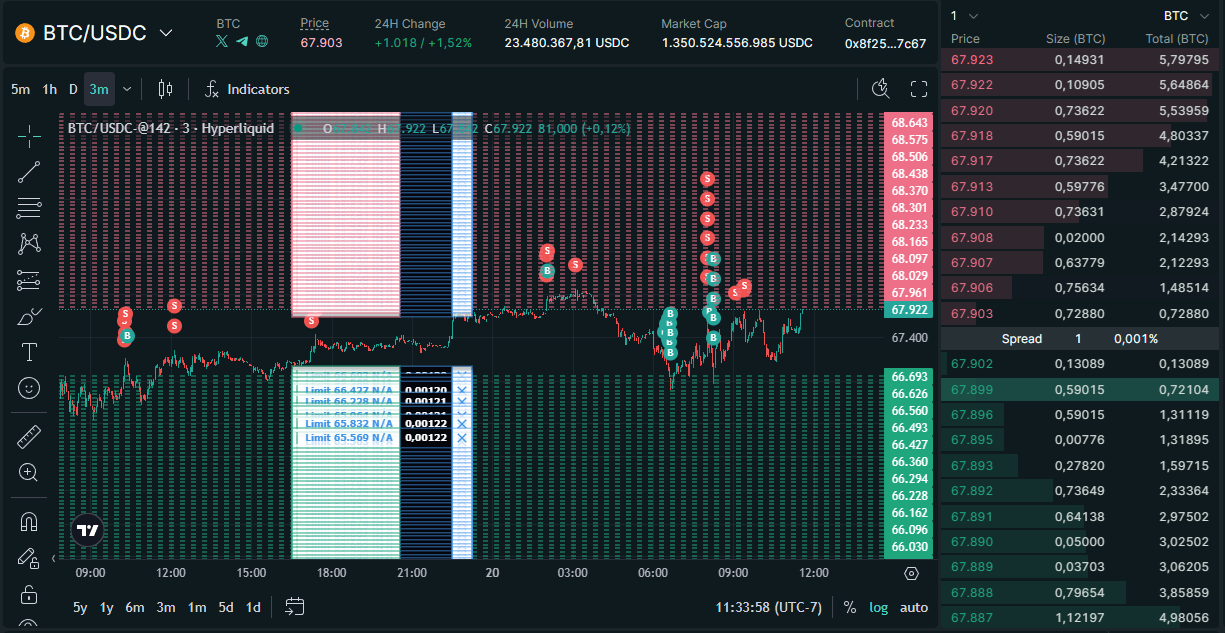
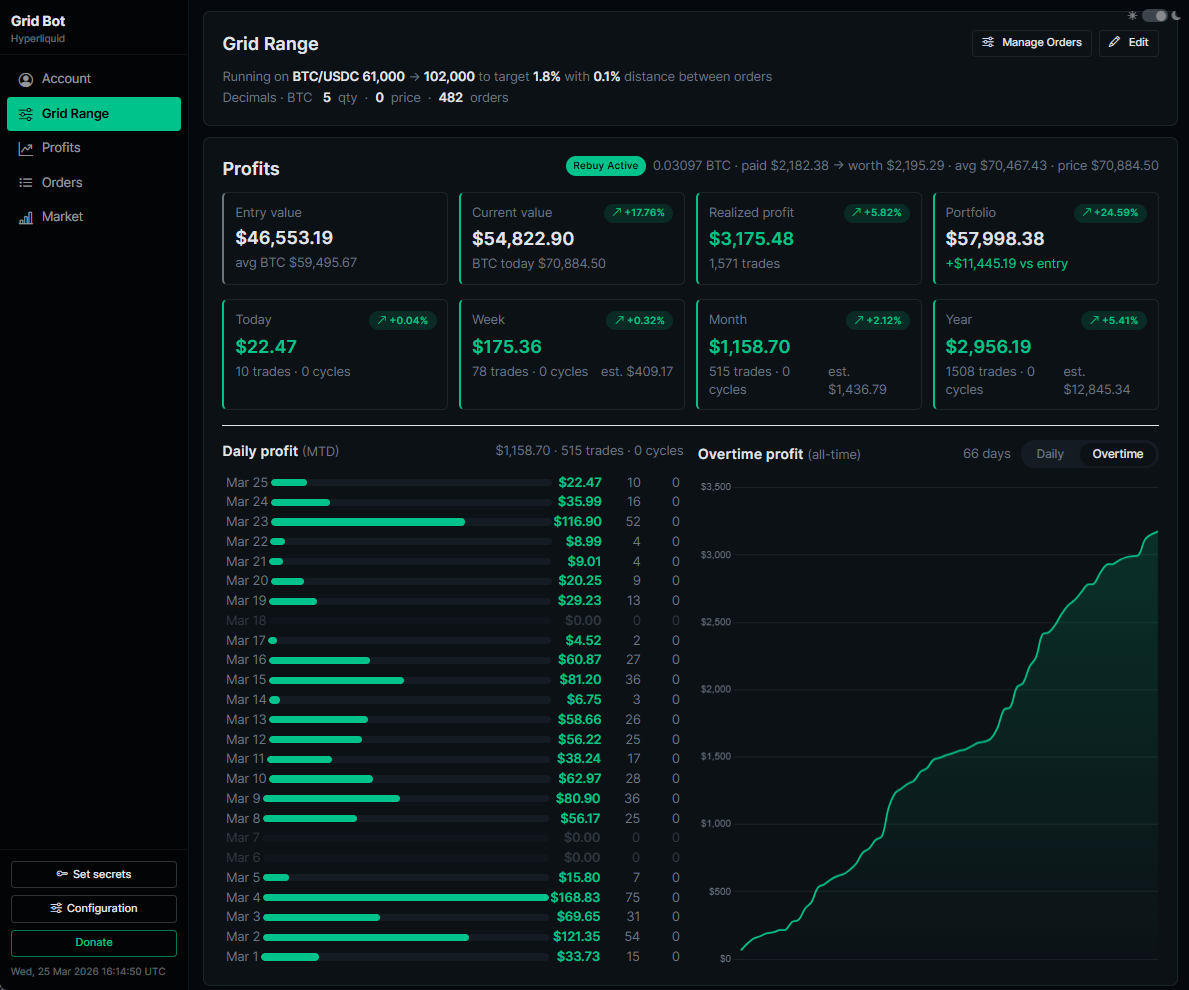
A working example with BTC / USDC, range $60,000–$100,000, rungs every 0.1%: that's roughly 500 buy/sell pairs covering the whole range. Every time price travels 1.8% within the range and reverses, one cycle completes — about 1.72% net after maker fees. The same strategy works on other pairs (ETH, SOL, HYPE) with their own configured ranges.
Our pricing is simple: a flat 5% commission on realized cycle profit — nothing on your capital, nothing on losses, and no subscription. So the ~1.72% above (net of Hyperliquid maker fees) becomes about 1.63% in your pocket after our cut. Our 5% only ever applies to what a cycle actually earns — and you can shave it down further with the referral rebate below.
Auto-compounding is optional — off by default, flip it on whenever you want. When enabled, a portion of every cycle's profit accumulates into a rebuy pool. When the pool reaches the configured threshold, the grid market-buys more of the underlying, compounding your position automatically. You decide how aggressively to compound — higher when price is in the bottom of the range (cheap), lower near the top — or leave it off and just collect cycles in stablecoin.
The grid listens to Hyperliquid's live price feed and reacts the moment price crosses a rung. A polling fallback runs every few minutes so nothing is missed if the live feed drops. You don't need to be at your computer for any of this.
Imagine BTC oscillates between $60,000 and $100,000 for two years and ends right where it started. A pure holder finishes those two years with exactly the balance they began with — zero return for two years of waiting. The same period through a grid captures dozens of cycles every month, each locking in roughly 1.72% net. The volatility a holder sits through and ignores is the grid's main source of profit.
Why this is safe
Most "trading bots" are pure cloud SaaS — you upload an API key to a server somewhere, and that server trades on your behalf. If that server gets breached, every user’s keys leak at once.
This product is built differently. The default flow uses Hyperliquid’s native agent system: a separate, trade-only sub-key that’s authorized by your main wallet but never is your main wallet. Here’s what actually happens when you sign up:
From step 3 onward, the cloud dashboard holds only your wallet address, your trading history, and your configuration — no key material that can move money. Your main key was never here, and the agent key lives on the offline engine machine. The agent itself is trade-only and scoped to your wallet, so the path from “something went wrong” to “funds gone” simply doesn’t exist.
Prefer pasting an API key the old-fashioned way? That path still works — same hardware-pull / cloud-nulled handling as the agent key. Either way, what the engine holds is a trade-only credential, never something that can move funds off Hyperliquid.
Revoke any time, two ways: from the dashboard (one click — deletes the agent key off the engine machine and resets your account to the "no keys" state), or directly on Hyperliquid by revoking the agent address on-chain. You stay in full control.
Advantages
-
Connect wallet, no key paste Sign up with MetaMask, Rabby, or any Web3 wallet. Your main key never leaves your device.
-
Trade-only agent key A separate Hyperliquid agent does the trading. It can only place orders — never withdraw or transfer.
-
Funds never leave your wallet The grid only places trades. It cannot move funds off the exchange.
-
Profitable in choppy markets Sideways volatility is the default state of crypto. Grids feed on it.
-
Optional auto-compounding Toggle on to re-buy the underlying from a share of each cycle's profit. Off by default.
-
Hands-off 24/7 Once configured, it trades while you sleep. Adjust whenever you want.
-
Per-account isolation Your keys, history, and Telegram channel are scoped to you alone.
-
Telegram alerts Optional pings on cycle completes, fills, and unusual events.
-
You stay in control Start, stop, pause, change the range, or revoke keys at any time.
-
Invite friends, rebate your fee Share your referral link: friends start with $5 in credit — enough to cover the fee on ~$100 of profit — and 1% of every cycle they close rebates against your 5% commission, lifetime, paid out of our margin, never added to anyone's costs. It's a fee rebate, not a payout.
Trade-offs & honest risks
No strategy is free money. Here is what to weigh before signing up.
-
Range-bound If price exits your configured min/max, the grid stops trading until price returns. Set the range too narrow and you stall; too wide and per-rung capital gets thin. Picking a sensible range is the most important decision.
-
Capital-intensive Hundreds of small limit orders need backing capital sitting on the exchange. The wider the range and the larger the order size, the more locked-up balance you need.
-
Not built for trends If your asset rallies past the top of the grid and never retraces, the grid will sell on the way up and then sit idle. Grids profit from oscillation, not directional moves.
-
Trust shifts to the host The trade-only agent key (or your API token, if you choose that path) is kept on a single private machine instead of a public cloud server. That's a deliberate trade-off: much smaller attack surface than cloud SaaS, with the trust placed in one host who keeps the machine secured (disk encryption, physical security, no public IP) rather than in a hosting provider. Your main wallet key is never on the host — and even in a worst case, the agent can only trade, never withdraw. The agent also auto-expires after ~180 days and can be revoked on-chain at any time.
-
Hyperliquid counterparty risk Funds sit on Hyperliquid while trading. If the exchange itself fails, freezes withdrawals, or is hacked, that is a risk you carry — same as on any exchange.
Who this is for
// good fit
- Holders who want their idle exchange balance to compound in choppy markets.
- People who refuse to upload keys to a faceless cloud SaaS.
- Traders comfortable adjusting a range every few weeks as conditions shift.
- Anyone who already trades on Hyperliquid and wants automated execution.
// not a fit
- Pure "set it and never look at it again" expectations — a wide range can run a month or more untouched (far more hands-off than concentrated liquidity pools), but ranges eventually drift and you'll want to revisit every few weeks.
- Pure trend-followers expecting one-way moves with no retrace.
- Anyone who can't tolerate any centralized-exchange counterparty risk.
- Users seeking leverage / shorting — this is a long-only spot grid.
Track record — what would have happened
Below: real backtest results, run on 1-minute candle data with the grid's default settings. Each row simulates “if I had used this grid for the past 6 months / 1 year” on that pair, ending April 30, 2026.
Get started
Sign up takes about a minute. Connect a Web3 wallet (MetaMask, Rabby, etc.), sign one login message, and approve a trade-only agent on Hyperliquid. Email is optional. Prefer the classic Hyperliquid API key path? That still works too.